


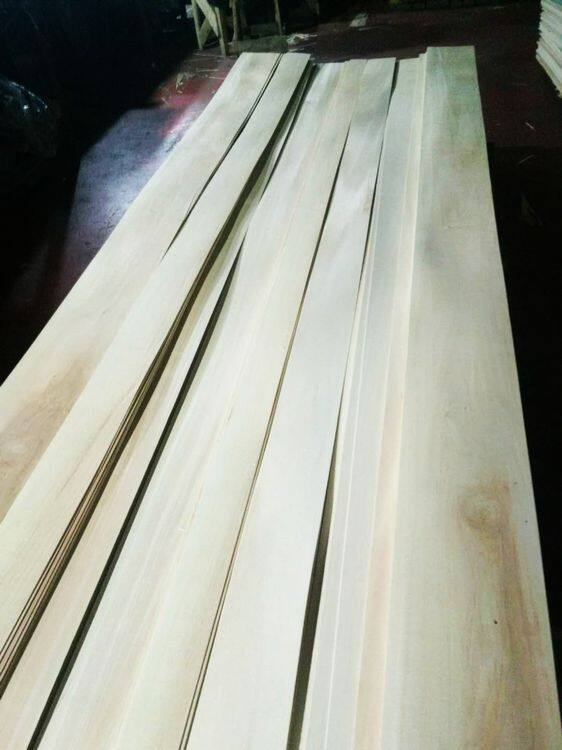
Product Parameters
|
Description |
|
|
Wood Name: |
Basswood |
|
Botanic Name: |
Tilia spp. |
|
Origin: |
China |
|
Thickness: |
0.40 mm |
|
Width: |
100 mm+ |
|
Length: |
1000-2000 mm/2000 mm+ |
|
Grain: |
Straight, crown |
|
Density: |
0.55 (after drying) |
|
Grade: |
A/B/C/D/E |
|
Grading Rule: |
HPVA standards |
|
Certification: |
N/A |
|
Application: |
Furniture, plywood panels |


What is Sliced Basswood Veneer
Sliced Basswood Veneer is creamy-white to pale pinkish-brown, straight grained, and has a fine even texture. It is a soft wood. Slicing refers to the direct crosswise or lengthwise cutting of logs using rotating circular saw blades to produce veneers. It is used for piano keys, bee hives and picture frames. This wood is odorless and is good for food containers.
Features of Sliced Basswood Veneer
Odorless, even during woodworking.
Very easy to process, the wood is soft and light, and can be easily hand-carved. No special treatment of the wood surface is required for finishing, polishing and gluing. However, it bends poorly and nails poorly when using the steam process.
The texture is beautiful and uniform, straight and fine. It has a moderate natural luster.
It is sustainable and widely distributed in North America and Europe. It is not included in the IUCN Red List of Endangered Species.
Prefers fertile and well-drained soil and moderate air humidity. It can grow in both shade and sun, but thrives in sun or partial sun.
Durability is very low in outdoor environments. They are rated as non-durable and cannot resist normal heartwood decay. Finished basswood products need to be painted to last for decades.
Low maintenance cost after polishing and coating.
Low price
In addition to producing one of the most used soft lumbers in the wood processing industry, Sliced Basswood Veneer is also known for hidden fibers in its bark's structure. Strong fibers can be extracted from basswood y peeling the outer layer of bark and keeping it in water for around a month. After that period, fibers will separate one from another, and they can be harvested and dried up. Archaeologists have found that clothes made from this fiber were in use in the Bronze age, and lime tree fiber is also today used for creating clothing in Japan.
Applications of Sliced Basswood Veneer
Sliced Basswood Veneer is used extensively to produce window shutters and blinds, plywood, veneer, wood pulp, and fiber products for commercial uses. On the other hand, woodworkers worldwide have found Sliced Basswood Veneer incredibly suited for producing intricate carvings of all sizes, statues, model building, marionette, and puppet making. since Basswood has great acoustic qualities, it is also extensively used to create various wind instruments, recorders, guitar and bass guitar bodies, recorders, drum shells, and others.
Carving and Sculpting
Sliced Basswood Veneer is often used for carving and sculpting due to its softness and uniform texture. Its fine grain allows for intricate details to be added to the piece, making it a popular choice among woodworkers and hobbyists. Additionally, it's easy to sand and paint, which means it can be finished to match any desired look.
01
Musical Instruments
Sliced Basswood Veneer is a common wood used in the construction of musical instruments due to its lightweight and resonant properties. It's often used to make guitar bodies, drum shells, and even violin bows. Basswood's natural resonance makes it an ideal choice for producing clear and vibrant sounds.
02
Packaging Materials
It's often used to make crates, pallets, and other shipping materials. Additionally, it's environmentally friendly as it can be easily recycled and reused.
03
Model Making
Sliced Basswood Veneer is often used to make architectural models, scale models of vehicles, and other miniature models. It's also a popular choice for creating prototypes, as it's easy to work with and can be shaped and sanded to the desired specifications.
04
How to Clean and Maintain Sliced Basswood Veneer
Although sliced basswood veneer furniture is durable, its paint surface is very easy to fade. For this reason, the furniture must be waxed frequently. You can first use a damp rag dipped in some neutral detergent to gently wipe the surface of the furniture. When wiping, follow the grain of the wood. After cleaning, wipe it with a dry rag or sponge dipped in professional wood wax. Waxing should be based on the center as the origin, first around the periphery and then in the middle. However, it is best not to wax too frequently, 1-2 times a year is best.
Because of its poor heat resistance, sliced basswood veneer furniture is best not close to hot places. In general, try to avoid sunlight exposure, because strong light will cause basswood furniture to fade; in addition, heaters and lamps that can emit strong heat will also cause basswood furniture to deform, so they should be kept away as much as possible; in addition, do not put hot cups, teapots and other things directly on basswood furniture, otherwise it will burn basswood furniture.
Basswood veneer processing technology


